

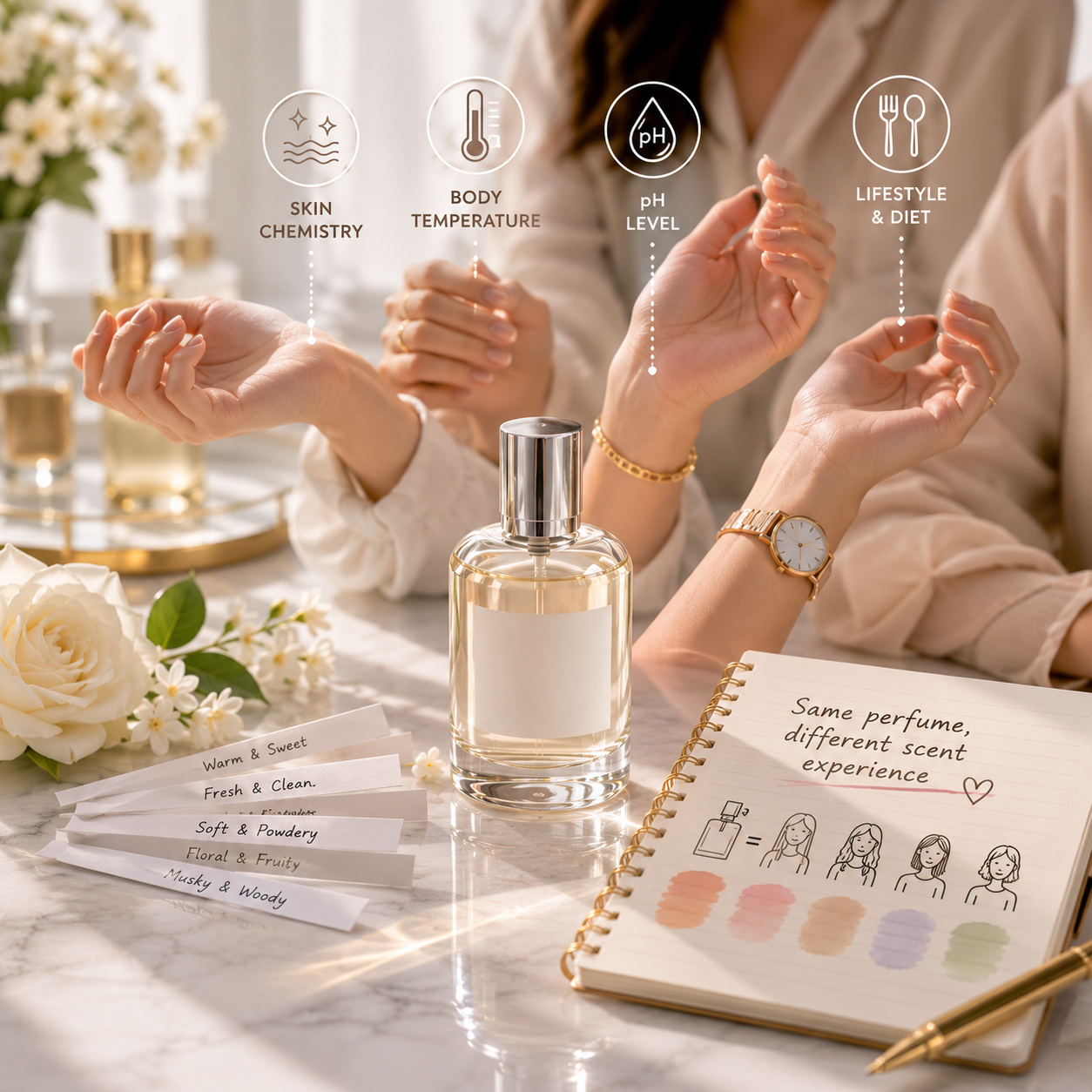
You and your friend buy the same perfume. On her, it smells warm and musky. On you, it goes sharp and fades within an hour. Same bottle. Completely different result.
This isn’t a coincidence — and it’s not a defective product. Your skin is doing exactly what it’s supposed to do.
Perfume doesn’t just sit on top of your skin — it reacts with it. Your skin has its own pH level, natural oils, sweat composition, and microbiome. These are unique to you, and they directly influence how a fragrance develops once it touches your skin.
Someone with naturally oily skin tends to hold fragrance longer — the oils help anchor the scent molecules. Someone with dry skin may find that the same perfume fades faster, because there’s less natural moisture to hold it in place.
Fragrance evaporates — that’s how you smell it. The warmer your skin, the faster the evaporation, and the stronger the scent projection. This is why perfume smells more intense on a hot day or after exercise.
Your natural body temperature also plays a role. People who run warmer tend to get stronger, faster scent development — the top notes bloom quickly, and the heart and base notes come through sooner.
What you eat affects how you smell — and therefore how your perfume smells on you. Spicy food, garlic, and red meat can alter your skin’s scent, which in turn affects how a fragrance blends with your body chemistry.
Hormonal changes — during your menstrual cycle, pregnancy, or menopause — can also shift your skin’s pH and oil production. Many women notice that a perfume they’ve worn for years suddenly smells different. Often, it’s not the perfume that changed.
This is one of the most practical differences. Fragrance clings to moisture. On oily skin, scent molecules have something to hold onto, which is why the fragrance lasts longer and stays truer to its original profile. On dry skin, the same perfume may smell fainter, sharper, or more fleeting — because the molecules evaporate faster without an oily base to anchor them.
If you’ve ever smelled a dupe perfume on someone else and thought it smelled incredible — then tried it yourself and found it different — this is exactly why. The fragrance oil itself hasn’t changed. Your skin has simply interpreted it differently.
This is also why it’s important to always test a fragrance on your own skin before committing to a full bottle. What blooms beautifully on someone else may need a little adjustment on you — a higher concentration, a different application spot, or layering with an unscented moisturiser.
Perfume is not a fixed thing. It’s a conversation between the fragrance and your body — and that conversation is different for everyone. The same scent can smell soft and floral on one person, warm and woody on another, and sharp and citrusy on a third.
This is what makes fragrance personal. And it’s exactly why finding your scent — one that works with your chemistry, not against it — makes all the difference.
Browse our full catalogue of 400+ inspired fragrance oils and find one that speaks to you. Or WhatsApp us — tell us what you usually wear, and we’ll help you find your match.