


You’ve sprayed your perfume, walked into a room, and nobody notices. Or a customer tells you their perfume smells great up close but disappears the moment they step back. Projection — the ability of a fragrance to radiate beyond your skin and be noticed by those around you — is one of the most common complaints in perfumery, and one of the least understood. The fix usually isn’t to spray more. It’s to understand what controls projection in the first place.
Sillage (pronounced “see-yazh”) is the French term for the trail or wake a perfume leaves as you move through a space. It’s distinct from longevity — a perfume can last for hours on skin but have very little sillage if the scent stays close to the body. Good sillage means people notice your fragrance when you enter a room or pass by. Poor sillage means the scent is essentially private — only detectable if someone is very close to you.
Neither is objectively better. Some people prefer intimate, skin-close fragrances. But if you’re expecting your perfume to project and it isn’t, these are the reasons why.
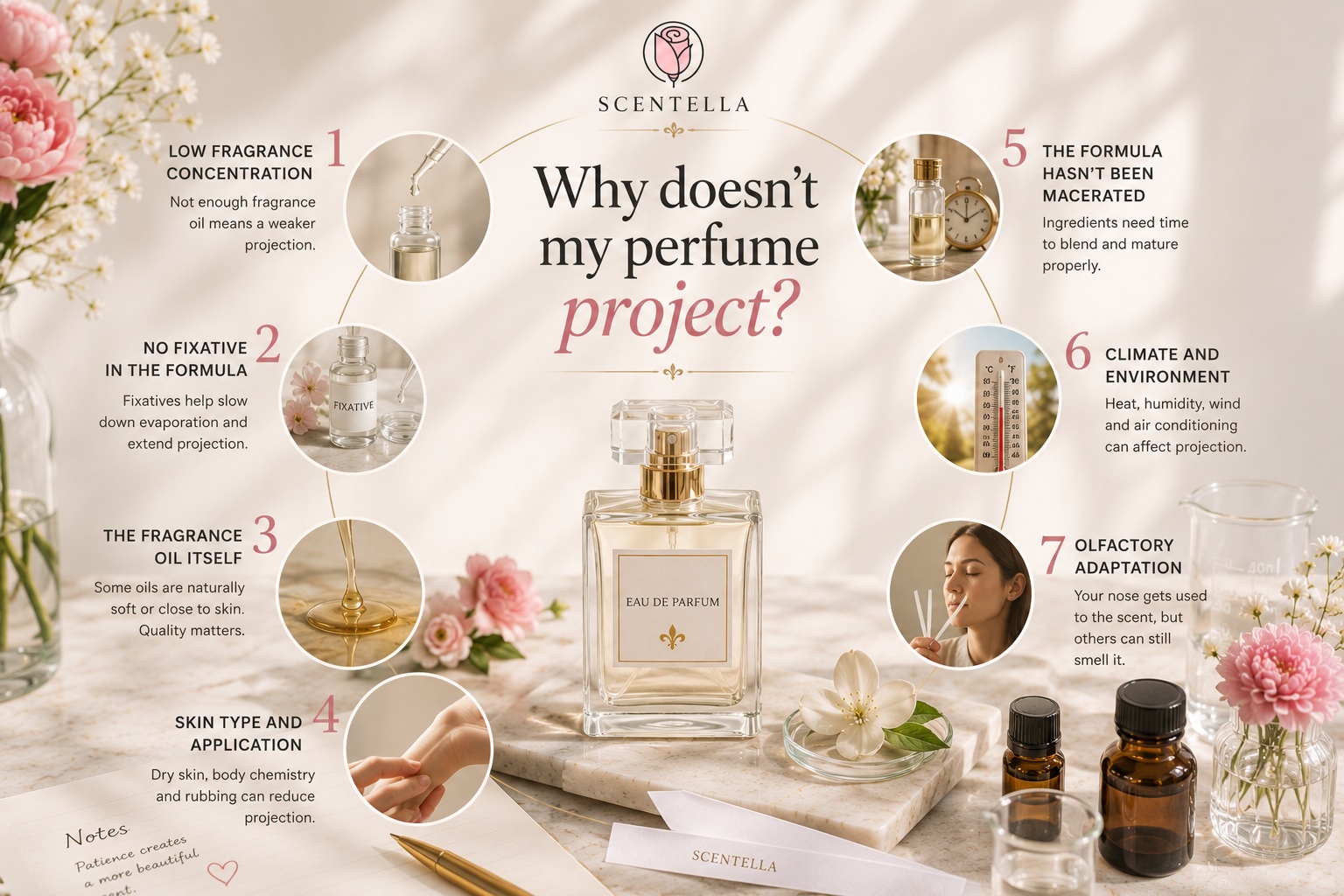
Concentration is the single biggest factor in projection. Higher concentration means more fragrance molecules are available to radiate off the skin and into the surrounding air.
If you or your customers are using a lower-concentration formula and expecting strong projection, that expectation needs to be managed — or the concentration needs to increase.
A fixative doesn’t just extend longevity — it also improves projection by helping fragrance molecules release more evenly and consistently from skin over time. Without a fixative, even a high-concentration formula can feel front-loaded: a burst of projection at application that fades quickly, rather than a sustained radiance throughout the wear.
If your dupe perfume formula projects strongly right after spraying but the sillage drops off quickly, this is often the cause. Adding a quality fixative smooths out the projection curve and maintains the scent trail for longer.
Not all fragrance oils project equally — and this is true even at the same concentration. Some fragrance families are inherently more projecting than others:
A customer who loves light fresh fragrances should understand that these are inherently intimate scents. A reseller formulating a citrus dupe should set customer expectations accordingly — or recommend layering with a heavier base to extend projection.
Dry skin absorbs fragrance rather than radiating it — there’s less surface oil to help molecules lift off and project into the air. Oilier skin holds and radiates scent more effectively.
Moisturising before application — unscented body lotion or petroleum jelly on pulse points — creates a surface that fragrance can cling to and project from, rather than being absorbed immediately.
Application technique also matters. Spraying at pulse points (wrists, neck, inner elbow, décolletage) where body heat is highest maximises projection. Hair also holds and releases fragrance effectively — a light spray on hair can significantly improve sillage.
Freshly mixed perfume often projects poorly compared to the same formula after maceration. The fragrance molecules haven’t fully integrated with the alcohol, and the balance between top, heart, and base notes is still unstable. After proper maceration — at least one to two weeks — the formula settles, and both longevity and projection improve significantly.
For resellers, this is one of the most actionable fixes: don’t bottle and sell fresh batches. Allow adequate maceration time before the formula reaches customers.
Malaysia’s heat and humidity affect projection in two opposing ways. On one hand, body heat increases fragrance diffusion — which should help projection. On the other hand, high ambient humidity can dampen sillage by weighing down fragrance molecules in the air.
In practical terms, heavy oriental and woody fragrances can project very well in Malaysian conditions. Lighter, fresher fragrances that already have minimal projection will perform even more modestly in heat and humidity.
Sometimes the perfume is projecting just fine — but the wearer can no longer smell it. Olfactory adaptation (nose blindness) means your brain stops registering a scent you’re continuously exposed to. People around you can still smell it clearly; you simply can’t.
This is especially common with musks, which the brain adapts to very quickly. If someone tells you they can’t smell their perfume but others can, this is almost certainly the cause.
For most people and most formulas, the answer to poor projection is one or a combination of:
For questions about concentration ratios, fixatives, or fragrance oil selection, WhatsApp us at 60176503882 or browse our range at scentella.com.my/products.
What’s the difference between projection and longevity?
Longevity is how long a fragrance lasts on skin. Projection (sillage) is how far it radiates into the surrounding air. A perfume can have excellent longevity but poor projection — lingering on skin for hours while remaining essentially undetectable to others. The best-performing fragrances have both.
Does spraying more perfume improve projection?
Up to a point — but it’s not the most efficient solution. Over-application can make a fragrance overwhelming without meaningfully improving the sillage trail. Addressing concentration, fixative, and application technique produces better results than simply spraying more.
Why does the same perfume project differently on different people?
Skin chemistry, body temperature, and natural skin oils all affect how fragrance radiates from the skin. Someone with naturally warmer body heat and oilier skin will project the same fragrance more than someone with cool, dry skin — sometimes significantly.
My customers say the dupe doesn’t project as much as the original. Why?
Several factors could contribute: concentration ratio, absence of fixative, maceration time, or the specific formulation of the fragrance oil. Designer originals are professionally formulated with optimal ratios and often include fixative compounds built into the composition. Ensuring your formula includes a fixative and adequate maceration time is the most reliable way to close this performance gap.