
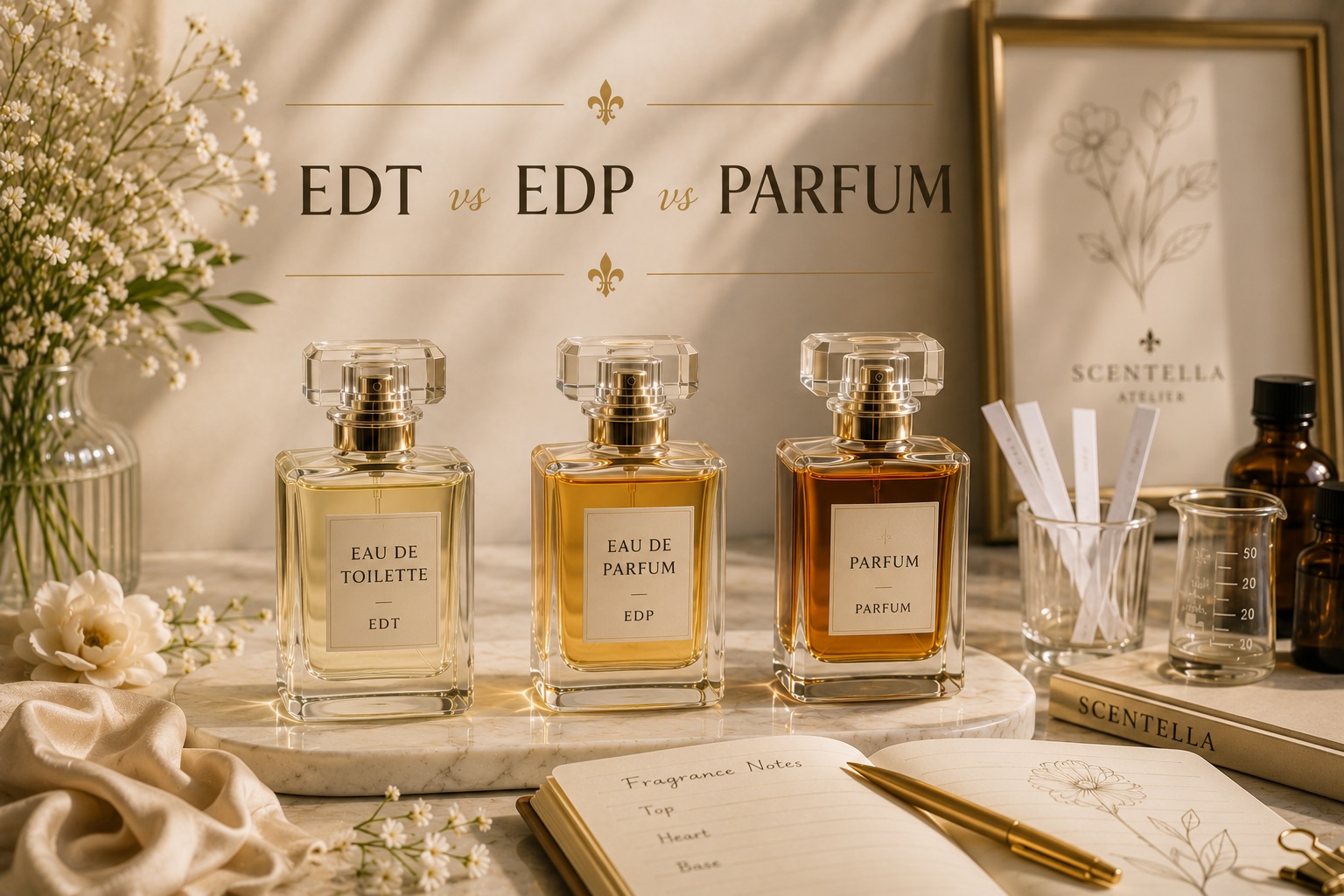
You’ve seen the letters on perfume bottles — EDT, EDP, Parfum — but what do they actually mean? And does it matter which one you choose? The short answer is yes, quite a lot. The difference determines how long your perfume lasts, how strong it projects, and ultimately whether you’re getting value for what you spend.
Every perfume is made up of two main components: fragrance oil (the scent) and a carrier — usually perfumer’s alcohol. The ratio between these two determines the concentration level, and the concentration level determines everything else.
Higher concentration = more fragrance oil = stronger scent, longer wear, higher price.
Lower concentration = more alcohol = lighter scent, shorter wear, lower price.
The various perfume types — EDC, EDT, EDP, Parfum — are simply different points on this concentration scale.
Fragrance oil concentration: 2–4%
The lightest and most diluted form. EDC is fresh, clean, and ideal for casual daytime use — but don’t expect it to last. Two to three hours is typical, and you’ll need to reapply frequently. Most body sprays and aftershaves fall into this category. It’s the most affordable option but least cost-effective if longevity matters to you.
Fragrance oil concentration: 5–15%
The most widely available perfume type on the market. EDT strikes a balance between wearability and longevity — typically lasting three to five hours. It’s lighter than EDP, which makes it well-suited for daytime wear and office environments where you don’t want the scent to be too dominant. Most mainstream designer perfumes are sold as EDT.
In Malaysia’s humid climate, EDT can feel short-lived — particularly lighter scent families like citrus or aquatic. Heavier EDT formulas with woody or oriental bases tend to perform better.
Fragrance oil concentration: 15–20%
The sweet spot for most people. EDP offers significantly better longevity than EDT — typically five to eight hours — with a richer, fuller scent projection. It tends to cost more than EDT but lasts long enough to justify the difference. For Malaysian weather, EDP is generally a smarter choice than EDT if you want the scent to carry through the day without reapplication.
Many perfume houses now release both EDT and EDP versions of the same fragrance. They’re not identical — the EDP version usually has a slightly different emphasis, with base notes more prominent and top notes slightly softer. Worth testing both if you’re choosing between them.
Fragrance oil concentration: 20–40%
The most concentrated and most expensive form. Parfum is intense, long-lasting — often eight to twelve hours or more — and typically applied in small amounts. A single application to pulse points is usually sufficient. Because of the high oil concentration, Parfum often feels richer, creamier, and more complex than the same fragrance in EDT or EDP form.
Parfum is ideal if you want a scent that genuinely lasts all day without reapplication and are willing to pay for it. It’s also worth noting that the high concentration means less product is used per application — so while the upfront cost is higher, a bottle can last longer than you’d expect.
When you make your own dupe perfume using fragrance oil and perfumer’s alcohol, you are essentially choosing your own concentration level. A higher ratio of fragrance oil produces something closer to EDP or Parfum strength. A lower ratio produces something closer to EDT.
This flexibility is one of the advantages of making your own — you can dial in exactly the concentration that works for your skin, your lifestyle, and how you want the scent to perform.
Browse Scentella’s fragrance oil collection at scentella.com.my/products — or WhatsApp us at 60176503882 if you need help choosing a concentration ratio for your formula.
Is EDP always better than EDT?
Not always — it depends on the occasion and your preferences. EDT is perfectly appropriate for daytime, office, and casual wear where something lighter is more suitable. EDP is better when you want longer wear and a richer scent presence. Neither is objectively superior — they serve different purposes.
Why does the same fragrance smell slightly different in EDT vs EDP form?
The higher oil concentration in EDP means the base and heart notes have more presence, while the top notes — which are more volatile — play a smaller role. EDP versions of the same fragrance often smell warmer, deeper, and slightly less fresh than their EDT counterparts.
Does higher concentration mean a stronger scent all the time?
Higher concentration means the scent is more intense at application and lasts longer as it fades. But it doesn’t mean it’s loud or overwhelming — projection also depends on the fragrance’s own character. Some EDPs are naturally soft and close to the skin; some EDTs are surprisingly projecting.
Can I mix fragrance oil at EDP or Parfum concentration myself?
Yes — and this is exactly what making your own dupe perfume allows you to do. A standard EDP-strength formula is typically around 15–20% fragrance oil in perfumer’s alcohol. For Parfum strength, go up to 25–30%. Start lower and adjust based on how the scent performs on your skin after maceration.