

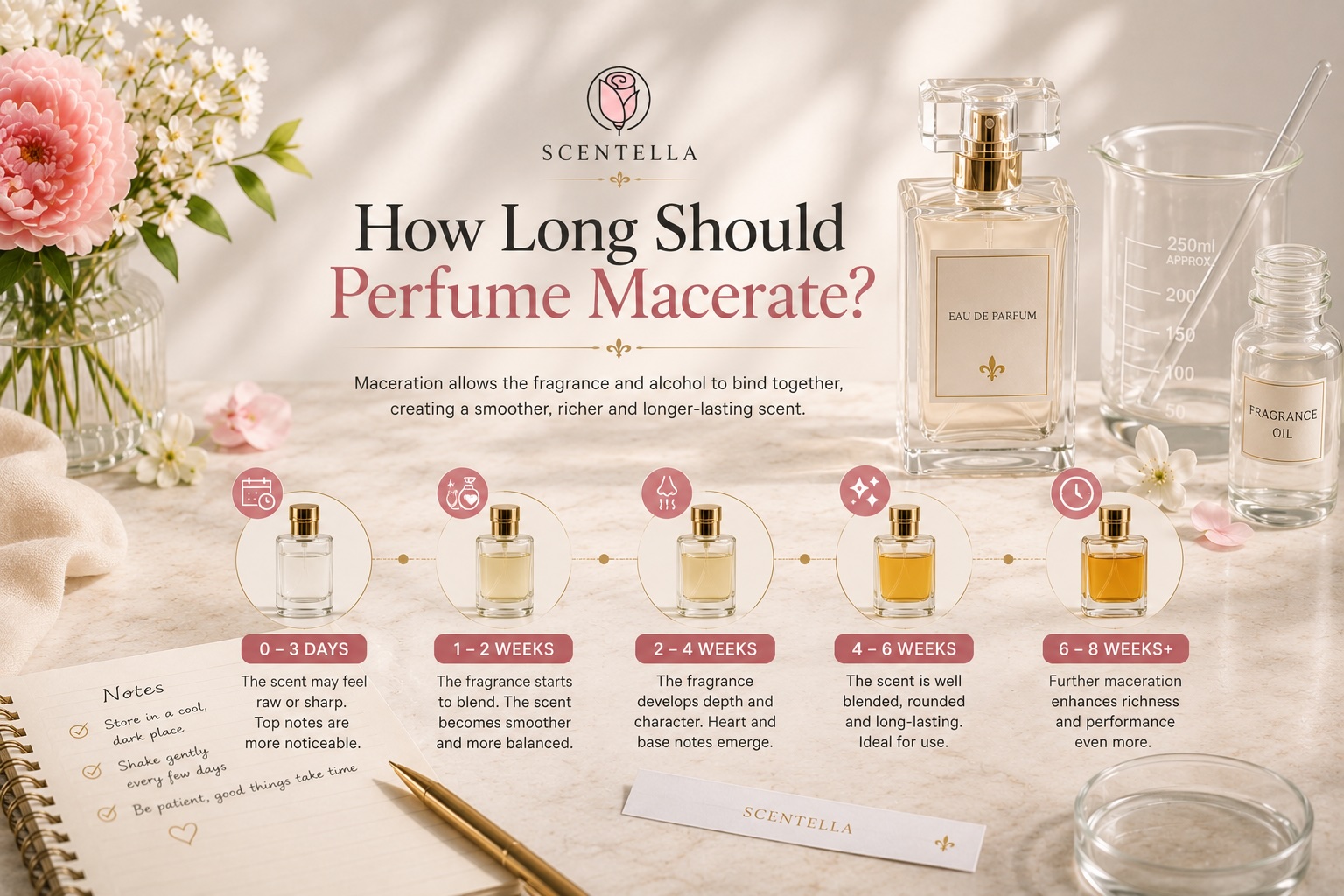
Maceration is not one-size-fits-all. The right resting time for a formula depends on several variables — the fragrance family, the oil concentration, and what you want the finished product to achieve. If you’re looking for a definitive guide to maceration timing for dupe perfume production, this is it.
For most dupe perfume formulas at standard EDP concentration (15–20%), the recommended maceration time is two to four weeks. This is the range that consistently produces the best balance of scent development, longevity, and projection.
However, this isn’t a hard rule — it’s a starting point. Here’s how to adjust based on what you’re working with.
Light citrus, aquatic, and fresh fragrances — 1 to 2 weeks minimum
These are the most volatile fragrance families. The top notes are light, fast-evaporating, and integrate relatively quickly. You’ll see meaningful improvement after just one week. However, even light fragrances benefit from a second week — the base and heart notes still need time to settle. Don’t be tempted to bottle early just because the opening smells good.
Florals and soft gourmands — 2 to 3 weeks
Floral and sweet gourmand compositions have more complex heart note structures that benefit from a longer maceration period. The integration between the floral heart and the base softens noticeably between week one and week three. Bottle at week two if you need to, but three weeks produces a noticeably more rounded result.
Woody, musky, and oriental fragrances — 3 to 4 weeks minimum
Heavy base note compositions — oud, sandalwood, amber, musk, resin-heavy orientals — take the longest to macerate properly. The large, heavy molecules in these oils need more time to fully dissolve and integrate into the alcohol. Bottling at two weeks will give you an acceptable result, but four weeks will give you a noticeably smoother, deeper dry-down. For premium formulas in this category, some perfumers extend maceration to six weeks.
High-concentration formulas (above 20%) — add one to two extra weeks
The more fragrance oil in a formula, the longer the integration process takes. If you’re formulating at Parfum strength (25–30%+), add at least one additional week to your standard maceration time. A 25% oriental formula needs at least five to six weeks to fully develop.
If production constraints require it, the absolute minimum maceration time before bottling for sale is 48 hours — but only for light, low-concentration formulas (EDT range, citrus or fresh families). For anything heavier or higher in concentration, 48 hours is insufficient and the product will underperform significantly.
A more realistic emergency minimum for most EDP-range formulas is two weeks. At this point the formula will have partially integrated and perform adequately — but it won’t be at its best. Always be transparent with yourself about the difference between “ready enough to sell” and “performing at its full potential.”
For questions about maceration, formulation, or fragrance oils, WhatsApp us at 60176503882 or browse our range at scentella.com.my/products.
Can I macerate for too long?
In practice, no — provided the bottle is properly sealed and stored in good conditions. Most formulas continue to improve over the first four to six weeks and then stabilise. Extended maceration beyond this point rarely causes harm, but the rate of improvement slows significantly. Poor storage conditions are a bigger risk than over-maceration.
Does maceration time affect colour?
Yes — some formulas deepen slightly in colour during maceration as the compounds integrate and certain molecules oxidise mildly. This is normal and cosmetic rather than a sign of degradation. A formula that smells good and performs well after maceration is fine to sell regardless of minor colour development.
Should I macerate with or without the fixative?
Always add all ingredients — fragrance oil, perfumer’s alcohol, and fixative — together at the mixing stage, then macerate the complete formula. Adding the fixative after maceration disrupts the integration process and produces inconsistent results.
What if the scent changes dramatically during maceration?
Some change is normal and expected — this is the point of maceration. Dramatic shifts (the scent becomes unrecognisable or develops an off-note) can indicate a formulation issue. Check your oil concentration, alcohol grade, and storage conditions. If the formula doesn’t improve after six weeks, the issue is likely upstream — in the fragrance oil quality or the alcohol.