


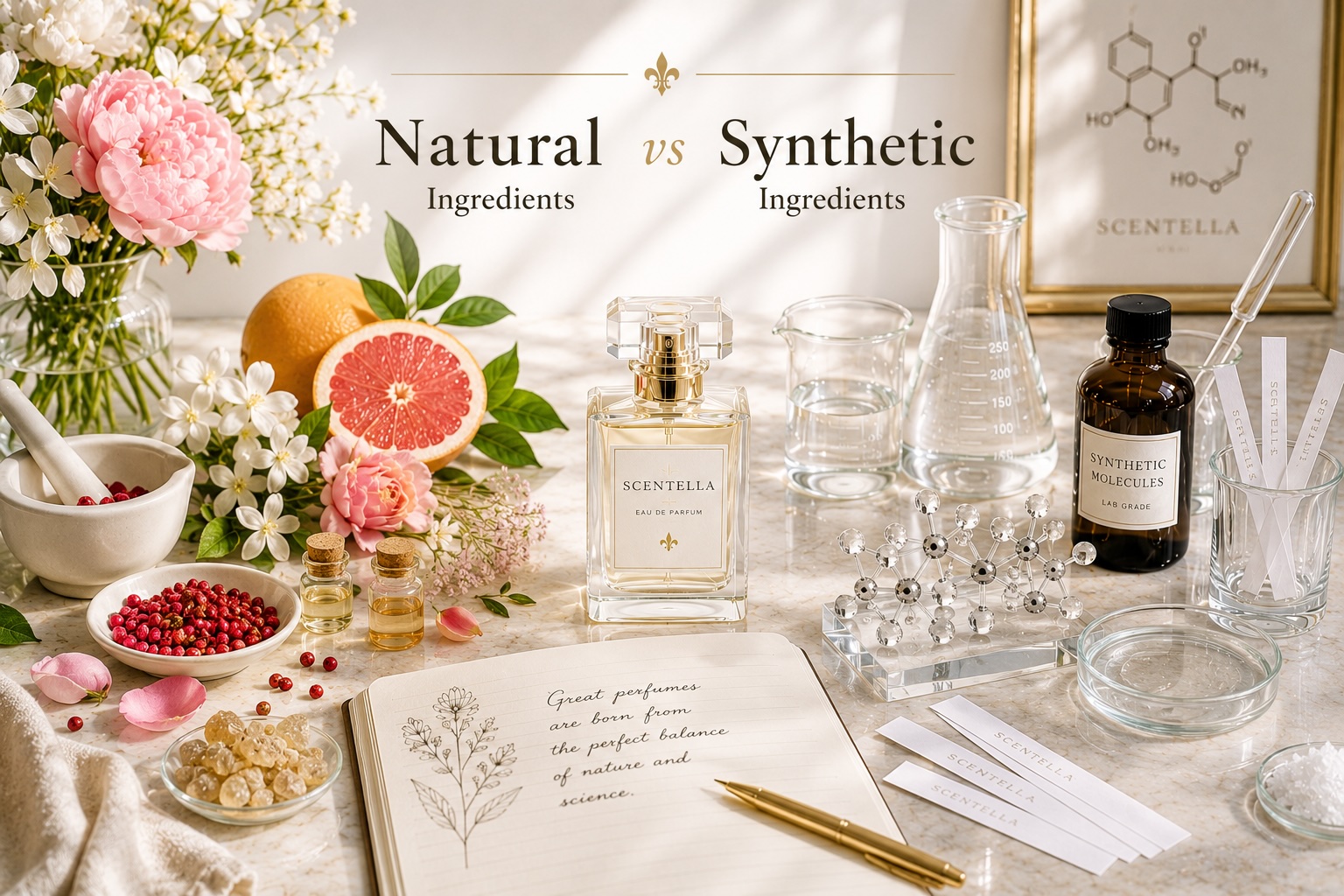
When people hear “synthetic fragrance,” many assume it means cheaper, inferior, or somehow unsafe. And when they hear “natural,” they assume it means pure, safe, and better. The reality is more nuanced than that — and understanding it helps you make smarter decisions whether you’re buying perfume for personal use or formulating your own.
Natural fragrance ingredients are derived directly from plants, animals, or minerals through physical or chemical extraction processes — steam distillation, cold pressing, solvent extraction, and so on. Common examples include:
Natural ingredients carry the full chemical complexity of the plant they came from — hundreds of individual aroma compounds in a single extract. This complexity is what gives naturals their depth and character. A real rose absolute smells different from a synthetic rose reconstruction precisely because of this molecular richness.
Synthetic fragrance ingredients are aroma chemicals created or isolated in a laboratory — either built entirely from non-natural starting materials, or isolated from natural sources and then reproduced chemically for consistency and scale.
They range from single aroma molecules (like linalool, limonene, or coumarin) to complex accords — pre-blended combinations designed to evoke a particular scent impression like “fresh linen,” “sea breeze,” or “oud.”
Synthetics exist for several reasons:
The assumption that natural ingredients are always superior is a marketing narrative, not a fragrance fact. Here’s why:
Natural doesn’t mean safe. Some of the most potent allergens and sensitisers in perfumery are natural — certain citrus oils cause phototoxic reactions on skin in sunlight, oakmoss is a common sensitiser, and cinnamon bark oil can cause irritation at high concentrations. IFRA restricts or limits many natural ingredients precisely because of their skin effects.
Synthetic doesn’t mean inferior. High-grade synthetic aroma chemicals are essential to modern perfumery. Iso E Super gives a woody, cedar-like smoothness that no natural can replicate. Hedione captures a radiant, diffusive jasmine quality that transformed how perfumers think about floral accords. Ambroxan — a synthetic recreation of ambergris — is one of the most widely used and beloved materials in contemporary fragrance.
Consistency matters. In a commercial or reselling context, consistency is critical. Natural rose absolute from one harvest may smell noticeably different from the next. A synthetic rose accord will smell identical every time — which is important when your customers expect the same fragrance every time they reorder.
The best fragrance oils — including the ones Scentella sources from France — use a carefully balanced combination of natural and synthetic ingredients. Naturals provide character, depth, and complexity. Synthetics provide consistency, stability, longevity, and access to scent impressions that nature alone can’t produce.
The quality of the synthetics used is what separates a good fragrance oil from a poor one. High-grade synthetic aroma chemicals perform better on skin, project more cleanly, last longer, and behave more predictably than cheaper alternatives. This is one of the key differences between fragrance oils from reputable French manufacturers and those sourced from lower-cost, lower-regulation suppliers.
If you’re buying perfume for personal use: don’t dismiss a fragrance because it contains synthetic ingredients. What matters is how it smells on your skin, how it performs, and whether the ingredients meet recognised safety standards like IFRA compliance. A well-formulated fragrance using quality synthetics will outperform a poorly-made “all-natural” one in almost every measure.
If you’re making dupe perfumes: the quality of the fragrance oil you start with determines everything. Understanding that your oil is a blend of naturals and synthetics — and that the quality of those synthetics matters — helps you evaluate suppliers more critically. A cheaper oil that smells similar in the bottle may perform very differently on skin, particularly in the dry-down where synthetic quality becomes most apparent.
For questions about our fragrance oils and sourcing, WhatsApp us at 60176503882 or browse our range at scentella.com.my/products.
Are synthetic fragrances safe to wear on skin?
High-grade synthetic aroma chemicals that meet IFRA safety standards are considered safe for skin use. In fact, some natural ingredients are more likely to cause sensitisation or allergic reactions than their synthetic counterparts. The key is whether the formula — natural, synthetic, or blended — meets established safety standards.
Can you tell the difference between natural and synthetic ingredients by smell?
Experienced perfumers can often distinguish, but for most people it’s not straightforward. A well-constructed synthetic accord can be indistinguishable from the natural ingredient it replicates. What most people perceive as “chemical” in a fragrance is usually a sign of low-quality synthetics — not synthetics in general.
Do natural fragrance oils last longer than synthetic ones?
Not necessarily. Some naturals — particularly heavy resins, woods, and musks — are very long-lasting. Others, like citrus oils, are extremely volatile and fade quickly. Many synthetics are specifically designed for longevity and fixative properties. The best-performing fragrances typically combine both.
Is “100% natural” perfume possible?
Technically yes, but practically limiting. A fully natural fragrance would be restricted to scents that can be physically extracted from plants or animals — which excludes many of the most beloved modern fragrance impressions. It also introduces significant batch-to-batch variation and higher cost. Most natural perfumers still blend with some synthetic materials to achieve consistency and stability.