

You spray a perfume, love it immediately and buy it. Three hours later you barely recognise it on your skin. Or the opposite — you dismiss a perfume in the store only to have a friend tell you it smells incredible on you an hour later. This isn’t a coincidence or a trick of memory. It’s how perfume is designed to work. Every fragrance has three distinct layers — top notes, heart notes and base notes — and they don’t all arrive at once.
Fragrance molecules evaporate at different rates depending on their molecular weight and volatility. Lighter molecules lift off the skin quickly — you smell them first, and they disappear first. Heavier molecules take longer to warm up and release, but once they do, they linger for hours.
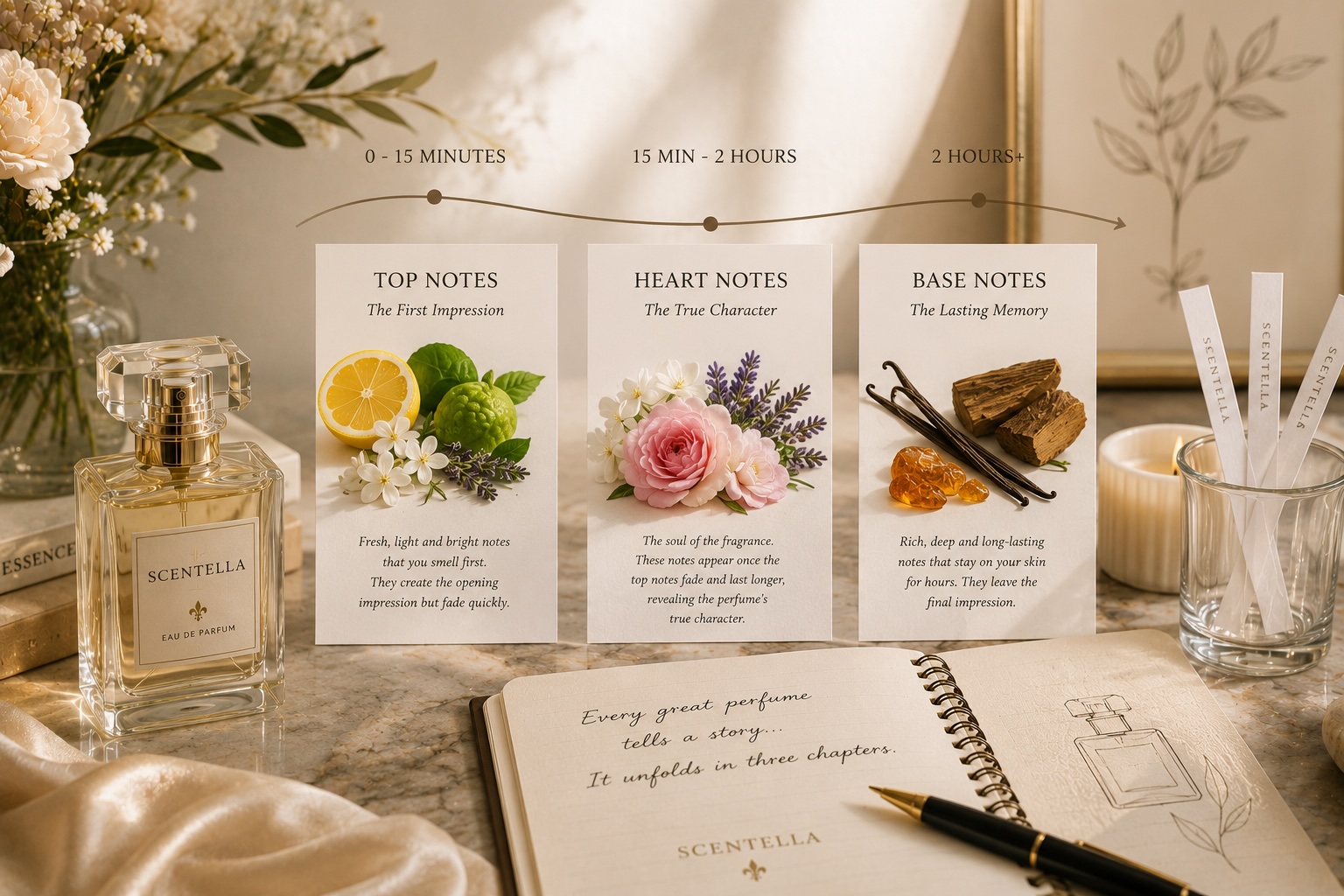
Perfumers deliberately build on this principle. A well-constructed fragrance is a journey in three acts, not a single static smell. The opening is designed to attract attention. The middle is designed to define the character. The base is designed to leave a lasting impression.
Top notes are what you smell in the first few minutes after application — the immediate, vivid burst of scent that hits you first. They’re usually light, fresh, and bright: citrus, herbs, light fruits, green accords. They’re designed to create a strong first impression and pull you in.
Here’s the thing most people don’t realise: top notes are the least representative part of a fragrance. They evaporate within 15 to 30 minutes. What you smell on the strip in a perfume shop — or immediately after you spray — is almost entirely top notes. Basing a perfume purchase on this alone is one of the most common and costly mistakes in fragrance buying.
Common top note ingredients: bergamot, lemon, grapefruit, orange, lime, basil, mint, ginger.
Heart notes — also called middle notes — emerge once the top notes have faded, usually between 15 minutes and an hour after application. These are the core of the fragrance: the notes that define what the perfume actually is and give it its personality.
Heart notes tend to be richer and more complex than top notes — florals, spices, fruits with more depth, green accords, light woods. They form the bridge between the fleeting opening and the lasting base. When someone says a perfume “opened up beautifully” on their skin, they’re usually talking about the heart notes emerging.
This is the stage where skin chemistry starts to play a meaningful role. The same heart notes can smell completely different on two people, depending on their natural pH, body heat, and skin moisture.
Common heart note ingredients: rose, jasmine, ylang-ylang, geranium, lavender, cardamom, cinnamon, black pepper, iris, peony.
Base notes are the foundation of the entire fragrance — the deep, rich, long-lasting materials that emerge fully after an hour or more and remain on skin for hours after the top and heart have faded. They’re usually heavy, warm, and grounding: woods, musks, resins, balsams, vanilla, oud.
Base notes do two jobs. First, they anchor the entire formula — giving the fragrance weight and staying power. Second, they blend with and support the heart notes during the dry-down, creating the overall impression the perfume leaves behind.
This is what you should evaluate a fragrance on — not the opening burst, but the dry-down. How does it smell two hours in? Is it still something you enjoy? That’s what you’ll actually be wearing all day.
Common base note ingredients: sandalwood, cedarwood, vetiver, oud, musk, amber, vanilla, benzoin, labdanum, patchouli.
The dry-down is the phase when the top notes have fully evaporated and the heart and base notes are working together. It usually begins around 30 to 60 minutes after application and represents the fragrance at its most personal and characteristic.
This is also the phase most affected by skin chemistry. The dry-down of the same perfume can smell noticeably different on different people — which is why testing on your own skin and giving it time is the only reliable way to evaluate a fragrance.
Never decide on a fragrance based on the first five minutes. Spray it on your wrist, go about your business, and come back to it after at least 30 minutes — ideally an hour. What you smell then is the fragrance you’ll actually be wearing. The opening is a teaser; the heart and base are the real thing.
For resellers formulating their own dupe perfumes, understanding the note structure of a fragrance is essential for two reasons.
First, it helps you evaluate the fragrance oil itself accurately. A high-quality dupe oil should replicate the character of the original across all three stages — not just the opening. If the dupe smells accurate on first spray but diverges significantly during the dry-down, that’s a formulation quality issue worth flagging.
Second, maceration directly affects how the notes develop and integrate. Freshly mixed perfume often has unbalanced notes — the top notes dominate and the base hasn’t fully emerged. After proper maceration, the three layers settle into each other and the fragrance performs as intended.
For questions about fragrance oils, formulation, or maceration, WhatsApp us at 60176503882 or browse our range at scentella.com.my/products.
How long do top notes last?
Usually 15 to 30 minutes, though some light citruses and greens can fade in as little as 10 minutes. Heavier top notes — spiced or herbal — may linger closer to 45 minutes before the heart begins to emerge.
How long do base notes last?
Base notes are the most enduring part of a fragrance — typically four to eight hours or longer, depending on concentration, skin type, and storage conditions. Some heavy base materials like oud and certain musks can remain detectable on clothing for days.
Is there a fourth layer — the dry-down?
The dry-down isn’t technically a separate layer — it describes the phase when the heart and base notes are working together after the top notes have gone. Some perfumers refer to it as the “soul” of the fragrance.
Can I tell all three stages from smelling the bottle?
Not reliably. Smelling from the bottle gives you a compressed, static impression of the fragrance but doesn’t replicate how it develops on skin with body heat and chemistry. Always test on skin for an accurate read.
Why does the same perfume smell different on different people?
Skin chemistry — pH levels, natural oils, body temperature, diet, and hydration — affects how each layer develops, especially the heart and base. This is why one person’s “perfect rose” smells soapy or powdery on another. The fragrance itself is the same; the skin is the variable.