
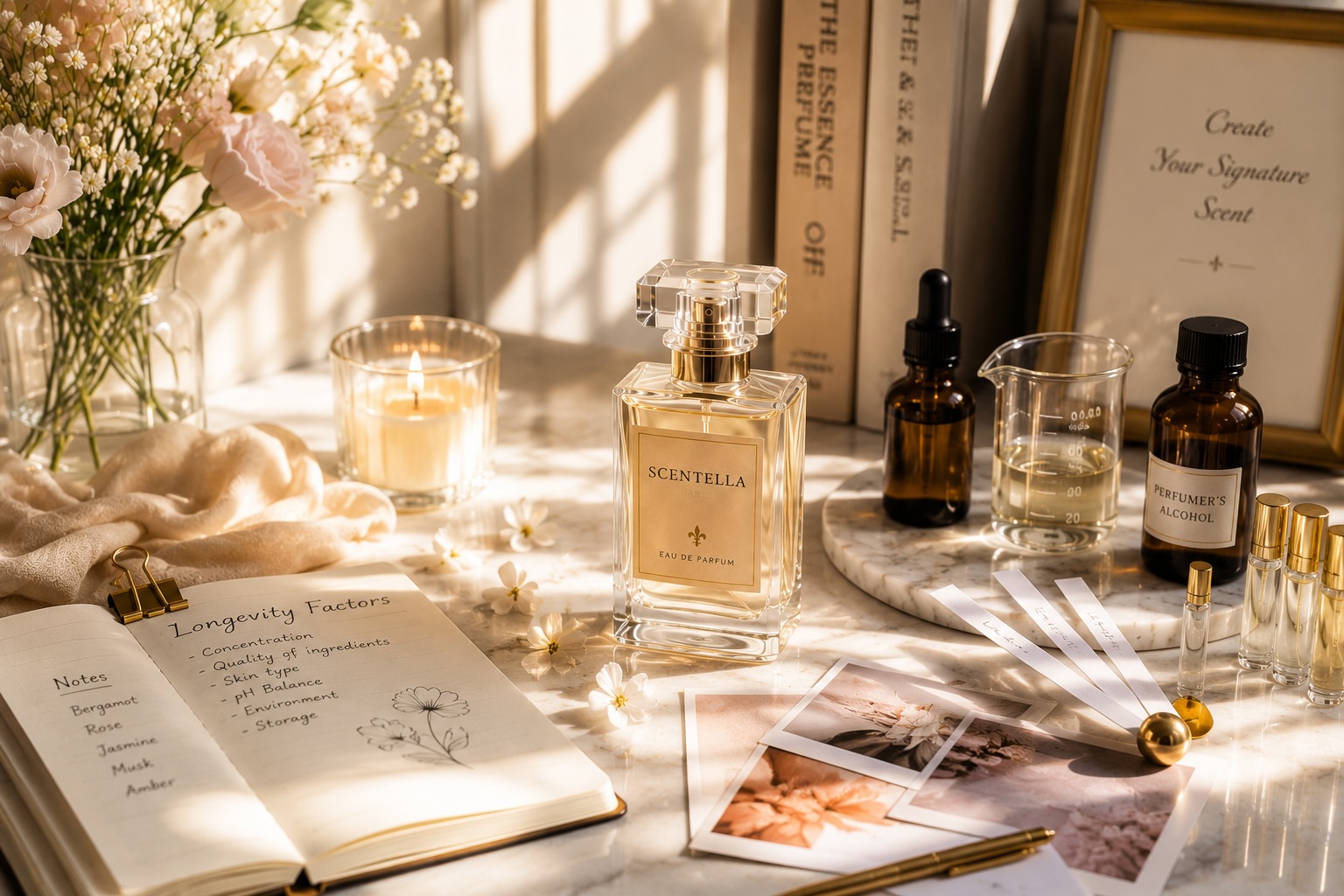
You spray your perfume in the morning and by midday it’s gone. You can’t smell it on yourself, your colleagues don’t notice it, and you’re wondering whether you wasted your money. Before you blame the perfume, it’s worth understanding what actually controls how long a scent lasts — because the answer is rarely just the quality of the fragrance.
This is the most underestimated factor in perfume longevity. Dry skin does not hold fragrance well. The oils in your skin act as a natural anchor for fragrance molecules — without them, the scent has nothing to cling to and evaporates quickly.
If you have naturally dry skin, your perfume will almost always fade faster than it would on someone with oilier skin — regardless of the quality of the fragrance. The fix is simple: moisturise before applying. Unscented body lotion or petroleum jelly on pulse points gives the fragrance something to hold onto and can significantly extend wear time.
Pulse points — wrists, neck, inner elbows, behind the knees — are the correct spots because body heat at these areas helps diffuse and project the fragrance. However, two common mistakes reduce effectiveness:
Heat and humidity accelerate fragrance evaporation. In Malaysia’s consistently warm and humid conditions, lighter fragrance families — citrus, aquatic, green, light floral — simply evaporate faster than they would in a cooler climate. This isn’t a flaw in the perfume; it’s physics.
If you find your perfume disappearing by midday in Malaysian weather, consider switching to or layering with a heavier fragrance family — oriental, woody, musky, or oud-based — which tend to have better longevity in heat. Alternatively, reapply strategically rather than expecting a single morning application to last all day.
Not all perfumes are created equal in terms of concentration. The higher the fragrance oil percentage relative to alcohol, the longer it tends to last:
If you’re mixing your own dupe perfume with fragrance oil and perfumer’s alcohol, your chosen ratio directly determines the concentration — and therefore the longevity — of your finished product.
A fixative is an ingredient that anchors fragrance molecules and slows their rate of evaporation from skin. Many DIY or entry-level dupe perfume formulas leave this out — which means even a high-quality fragrance oil will fade faster than it should.
If you are making your own perfume and longevity is an issue, adding a fixative to your formula is one of the most effective solutions. It doesn’t change the scent — it simply helps it stay longer.
If you’ve recently mixed a dupe perfume and it’s not lasting as expected, it may simply not have had enough time to develop. Freshly mixed perfume hasn’t fully integrated — the fragrance molecules haven’t bonded completely with the alcohol, and the scent hasn’t reached its full potential.
Allowing your formula to rest for at least one to two weeks before use — a process called maceration — significantly improves both the scent quality and longevity of a finished perfume.
Perfume stored in heat or light degrades faster, and degraded fragrance molecules evaporate more quickly and perform less well on skin. If your perfume has been sitting on a bathroom shelf or near a window, the formulation may have weakened before you even start using it.
Store in a cool, dark place — always. The difference in performance between a well-stored and poorly-stored perfume is more significant than most people realise.
For questions about fragrance oil concentration, fixatives, or maceration, WhatsApp us at 60176503882 or browse our range at scentella.com.my/products.
Why can I smell my perfume when I first apply it but not after an hour?
This is called olfactory fatigue — your nose adapts to a scent you’re continuously exposed to and stops registering it. This doesn’t mean the scent has disappeared; others around you can often still smell it. Try smelling your inner elbow to reset your nose, then check your wrist again.
Does expensive perfume last longer than cheap perfume?
Not automatically. Price doesn’t directly determine longevity — concentration and formulation do. A high-quality fragrance oil at the right concentration and with a proper fixative will outlast an expensive spray with a low oil concentration.
Why does the same perfume last longer on my friend than on me?
Skin chemistry, body heat, hydration levels, diet, and even hormone levels all affect how fragrance develops and lasts on different people. There’s no universal formula — what works brilliantly on one person may fade quickly on another.
Is it better to apply perfume to skin or clothes?
Both have a place, but skin application is generally more effective for longevity and scent development — your body heat and chemistry actively engage with the fragrance. Clothes application can work well for projection but loses the personal, evolving quality that makes a fragrance truly yours.