

You open a bottle of perfume you haven’t used in a while and notice the liquid looks darker than you remember. Or a customer messages you saying the colour of their perfume has changed. Is it spoiled? Is it normal? Should you be concerned?
The short answer: colour change in perfume is common, usually natural, and often not a sign that anything is wrong. But not always. Understanding why it happens helps you — and your customers — tell the difference.
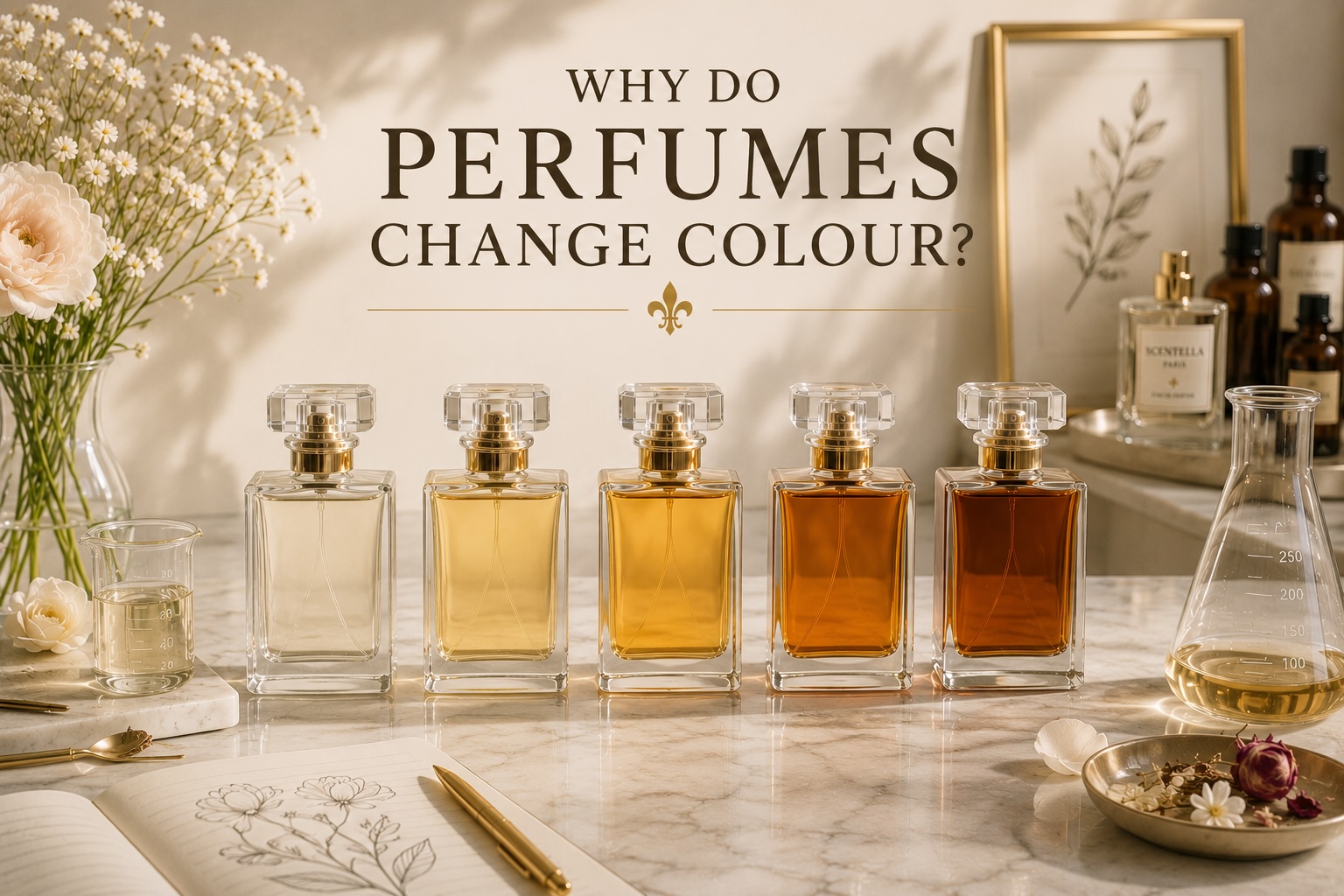
Oxidation is the most common cause. When fragrance compounds are exposed to oxygen — whether through opening the bottle, a loose cap, or simply through the bottle walls over time — they oxidise. This is the same process that causes cut fruit to brown or metal to rust. The fragrance molecules react with oxygen and produce slightly different compounds, some of which are darker in colour. A clear or pale yellow perfume can gradually turn amber or brown through oxidation alone.
UV light exposure accelerates the process significantly. Certain fragrance ingredients — particularly natural ones like citrus oils, florals, and resins — are photosensitive. When exposed to sunlight or strong artificial light, they break down faster and often darken. This is why many perfumes are sold in tinted or opaque bottles, and why storage away from light matters.
Heat also plays a role. Higher temperatures speed up chemical reactions including oxidation. A perfume stored in a warm environment — a bathroom shelf, a car, a sunlit dressing table — will undergo colour change faster than one stored in a cool, dark place.
The natural ingredients themselves can contribute to colour change over time independent of external factors. Certain raw materials — oud, vanilla, labdanum, musks, some citrus extracts — are naturally darker and can deepen the colour of a formula as they continue to develop. This is sometimes called “ageing” rather than degradation, and in certain fragrance families it actually improves the scent rather than harming it.
Not necessarily — and this is important for both personal users and resellers to understand. Colour change alone is not a reliable indicator of whether a perfume is still good. A perfume that has darkened significantly may still smell exactly as it should and perform well on skin. Conversely, a perfume that looks perfectly clear may have degraded in ways that aren’t visible.
The most reliable indicators of actual spoilage are:
Colour change without any of the above is most likely natural and cosmetic rather than functional.
If you’re selling dupe perfumes, colour change is something your customers will notice and occasionally question. The best approach is to get ahead of it — educate your buyers at the point of sale that some colour development over time is normal, particularly for formulas with natural-derived ingredients or heavier base notes.
More importantly, proper storage significantly slows the process. Reminding customers to store their perfume in a cool, dark place — away from bathrooms and direct sunlight — reduces the likelihood of colour change complaints and extends the perceived quality of your product.
For your own stock, the same rules apply. Storing fragrance oil or mixed perfume in ideal conditions preserves both colour stability and scent integrity for longer.
Have questions about fragrance oil quality, formulation, or storage? WhatsApp us at 60176503882 or browse our range at scentella.com.my/products.
Is it safe to use a perfume that has changed colour?
In most cases, yes — if it still smells as expected, hasn’t developed cloudiness or sediment, and doesn’t cause skin irritation, a colour change alone is not a reason to discard it. Always do a patch test on a small area of skin if you’re uncertain.
Why do some perfumes change colour faster than others?
Formulas with a higher proportion of natural ingredients tend to change colour faster than fully synthetic ones. Ingredients like citrus oils, florals, vanilla, oud, and resins are particularly prone to darkening. Storage conditions play a significant role too.
Can colour change affect the scent?
Sometimes. If the colour change is caused by oxidation or light degradation, the scent may also shift — particularly the top notes, which are the most volatile and the first to be affected. If colour change is accompanied by a noticeably different smell, the formula may have degraded beyond normal ageing.
Does a clear perfume mean it’s better quality?
No. Colour is not a measure of quality. Many high-quality perfumes — particularly those with natural, complex bases — are naturally amber or golden in colour. Clarity depends on the ingredients used, not the quality of the formula.