
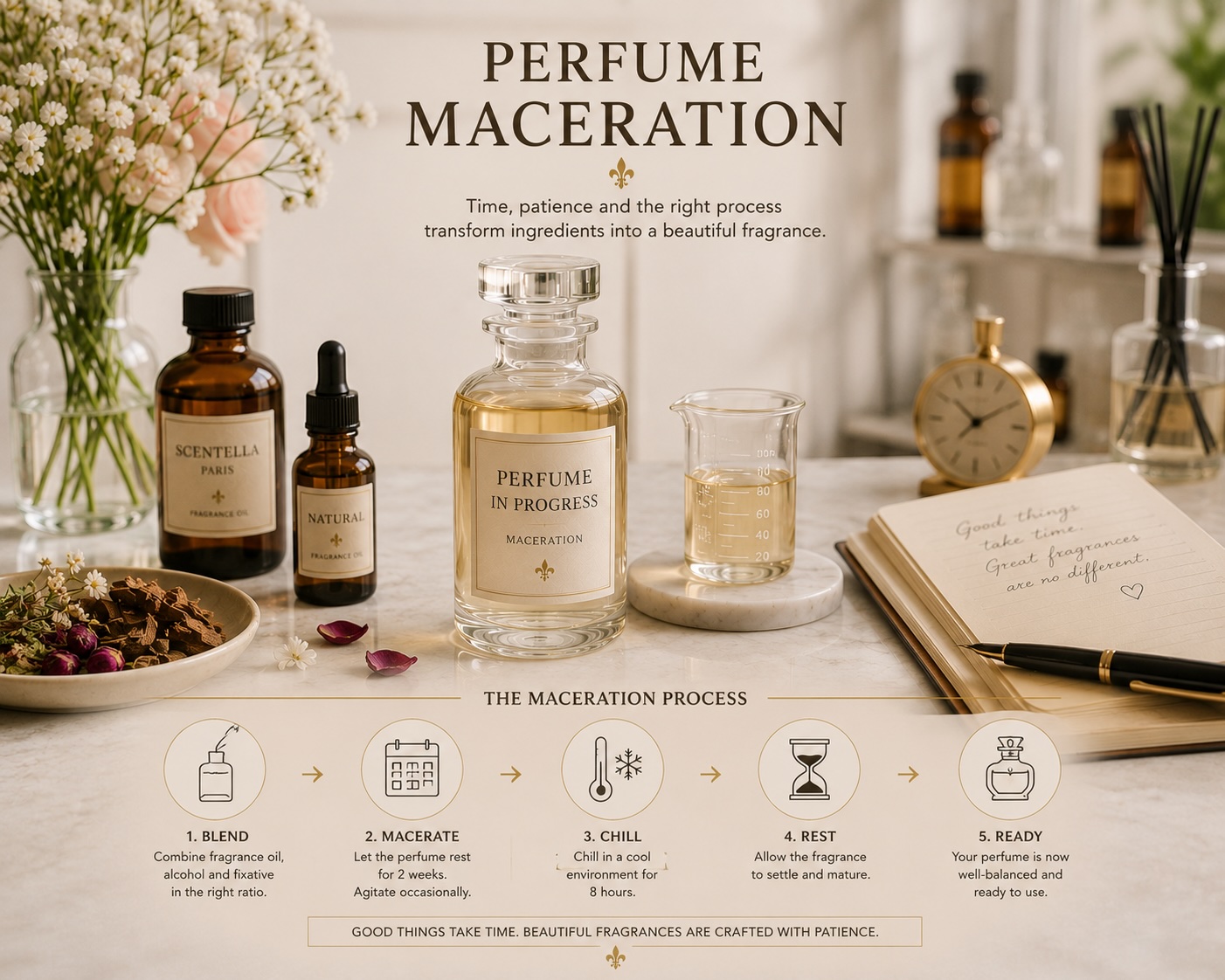
If you’ve ever mixed a batch of dupe perfume, sprayed it immediately, and felt like the scent wasn’t quite right — flat, sharp, or just not as good as expected — maceration is probably what was missing. It’s one of the most overlooked steps in perfume formulation, and one of the most impactful. Getting it right doesn’t cost anything extra. It just costs time.
Maceration is the resting period that follows the initial mixing of fragrance oil and perfumer’s alcohol. Once you combine your ingredients and seal the bottle, the formula needs time to settle — for the fragrance molecules to fully dissolve into the alcohol, integrate with each other, and develop into a cohesive, balanced scent.
Think of it like brewing tea. The moment hot water hits the tea leaves, you have tea — but it hasn’t fully developed yet. Leave it to steep and the flavour deepens, rounds out, and becomes what it’s supposed to be. Perfume maceration works the same way. The mixing is just the beginning.
When fragrance oil is first added to alcohol, the various aromatic compounds in the oil don’t immediately integrate evenly. Some molecules dissolve quickly, others more slowly. The top notes — lighter, more volatile compounds — tend to dominate early. The heavier base notes haven’t fully expressed themselves yet.
During maceration, a gradual chemical process takes place: the compounds continue to dissolve, intermingle, and bond. The overall composition settles into balance. The result is a more harmonious, rounded scent — one where the top, heart, and base notes work together rather than competing.
This is why a freshly mixed perfume can smell sharp, alcoholic, or one-dimensional compared to the same formula after proper maceration.
Lighter, citrus-forward or fresh fragrances can be ready sooner. When in doubt, give it more time — maceration won’t harm the formula, and longer is almost always better.
If you are selling dupe perfumes, your customers are comparing your product to a professionally formulated original. That original has been macerated — often for weeks or months — before it ever reaches a customer. A freshly mixed dupe will almost never match the original’s performance straight out of the bottle.
Building maceration time into your production process is one of the simplest and most cost-effective ways to close that gap. It requires no additional ingredients, no additional equipment — just discipline in your workflow. Mix in advance, macerate properly, and bottle for sale only when the formula has fully developed.
Customers who notice their dupe smells slightly different from what they expected may simply be receiving a product that hasn’t been given enough time to develop. That perception becomes a quality issue that affects repeat purchases and word of mouth.
Some resellers bottle their perfume and then tell customers it will “settle” after a few days. This is partially true — a freshly bottled perfume can improve slightly with time after purchase. But this is not a substitute for proper maceration before bottling. The maceration process should happen in your production, not in your customer’s hands.
For questions about formulation, fragrance oils or ingredients, WhatsApp us or browse our range at scentella.com.my/products.
Does maceration work the same for all fragrance concentrations?
Yes, but higher concentration formulas typically benefit from longer maceration. There’s more material to integrate, and the heavier compounds take more time to fully develop. A lighter concentration may be wearable sooner, but still improves with time.
Can you macerate for too long?
In practice, no — as long as the bottle is properly sealed and stored correctly. Most fragrances continue to improve over weeks and stabilise after that. Proper storage is the key variable.
Should I add fixative before or after maceration?
Add all ingredients — fragrance oil, perfumer’s alcohol, and fixative — together at the mixing stage, then macerate the complete formula. Adding ingredients at different stages disrupts the integration process and produces inconsistent results.
Why does my dupe smell different from the original even after maceration?
Several factors can contribute — the quality of the fragrance oil, the accuracy of the dupe formulation, and the concentration ratio. Maceration ensures your formula performs at its best, but it cannot compensate for differences in the oil itself. Starting with a high-quality, accurately formulated fragrance oil is the foundation everything else builds on.