
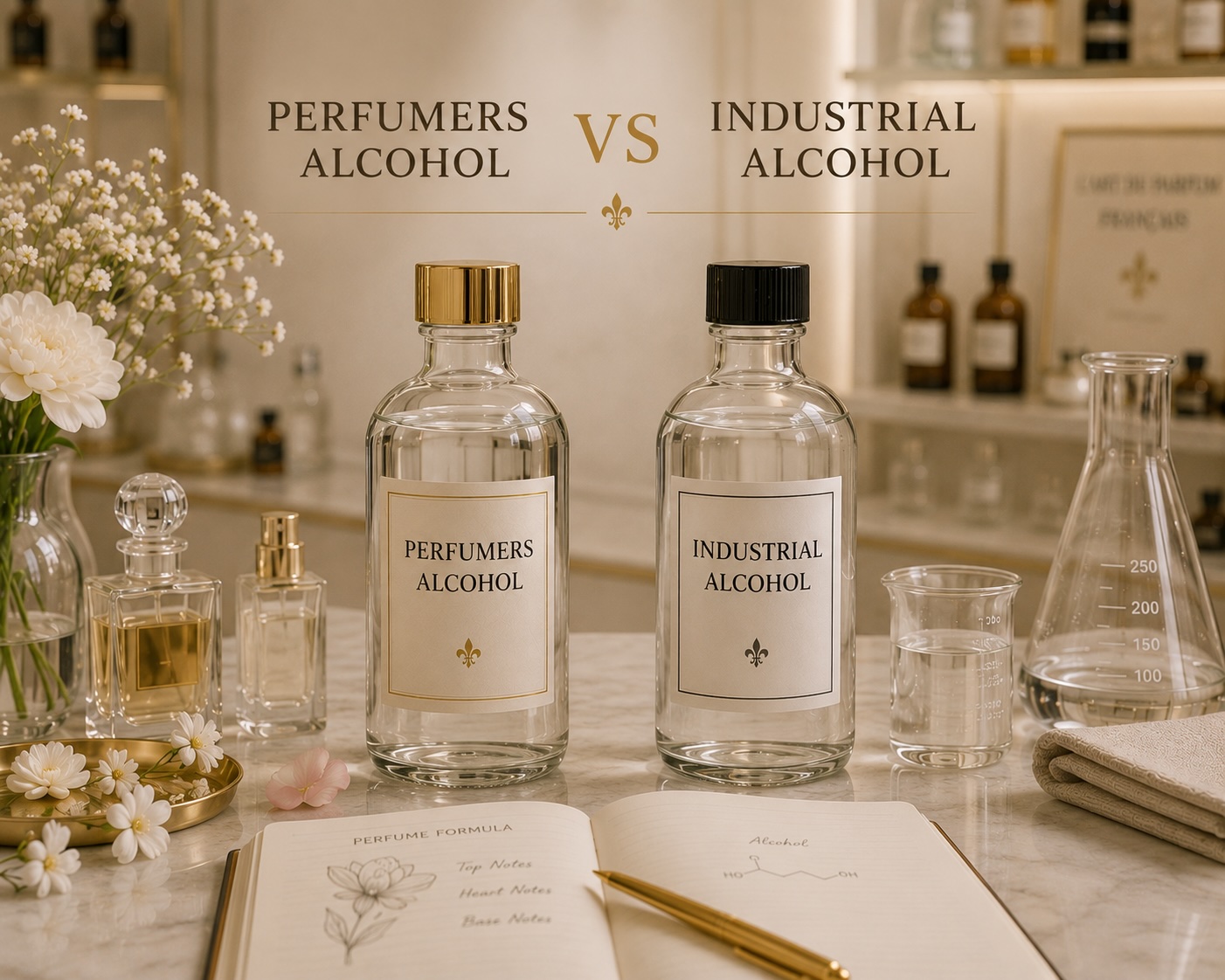
When you’re building a dupe perfume business, the focus tends to go on the fragrance oil — which scents to carry, how to mix, how to price. But there’s another ingredient in your formula that deserves just as much attention: the alcohol. Specifically, whether it’s the right grade for skin use. Getting this wrong isn’t just a quality issue. It’s a safety issue — and it’s one that many resellers don’t fully understand until something goes wrong.
Perfumer’s alcohol is high-purity ethanol — typically 95–96% concentration — that has been produced and processed to a standard safe for direct skin contact. It is the industry-accepted carrier for fragrance oils in spray perfume formulation. When mixed with fragrance oil at the right ratio, it dissolves the oil cleanly, projects the scent properly when sprayed, and evaporates quickly without leaving residue on skin.
The key word is purity. Perfumer’s alcohol is produced under controlled conditions, tested for contaminants, and verified to meet safety standards for topical use. It is what reputable fragrance suppliers, perfume houses, and professional formulators use — because it is what the finished product requires.
Industrial-grade alcohol is ethanol produced for non-consumable, non-cosmetic applications — cleaning agents, solvents, fuel, manufacturing processes. It is not produced to skin-safe standards, and critically, it often contains denaturants or impurities that are toxic or harmful to human skin.
Industrial alcohol is significantly cheaper than perfumer’s alcohol. That price difference is the primary reason some suppliers use it — knowingly or unknowingly — in perfume formulations sold to resellers who may not know what they’re buying.
Here is the part that most people don’t know — and that every perfume reseller should understand clearly: you cannot reliably distinguish perfumer’s alcohol from industrial alcohol by smell alone.
Both are ethanol. The ethanol molecule itself smells the same regardless of grade. The difference lies in what else is present — the denaturants, residual impurities, and processing byproducts that vary between grades. Some of the most dangerous of these, including methanol, are colourless and nearly odourless at low concentrations. Your nose will not catch them.
This is not a theoretical concern. Methanol contamination in alcohol products is a documented global problem. At low concentrations it causes skin irritation; at higher concentrations it is toxic. And because it smells similar to ethanol, neither you nor your customers would know it was there — until there’s a reaction.
A Certificate of Analysis (COA) is an important document — it states what the supplier claims is in the alcohol. Reputable suppliers provide accurate COAs as part of verified quality control processes.
However, a COA is only as reliable as the supplier issuing it. Unscrupulous suppliers in unregulated markets have been known to provide falsified documentation. A COA from an unverified source tells you what that supplier wants you to believe — not necessarily what is in the bottle.
This means documentation matters, but it is not sufficient on its own. The most important protection is who you buy from — a supplier with a verifiable track record, accountability, and repeat customers who can vouch for the product’s safety and consistency.
As a perfume reseller, the alcohol you use goes directly onto your customers’ skin. If you are using industrial-grade alcohol in your formulation — even unknowingly — you are exposing your customers to a potential health risk. The liability for that sits with you, not your alcohol supplier.
Beyond safety, there are performance reasons to use the correct grade. Industrial alcohol can interfere with fragrance development, alter the scent profile, cause cloudiness in the finished perfume, and affect longevity. A formula that performs inconsistently or develops an off-note is often traced back to alcohol quality, not the fragrance oil.
At Scentella, we supply perfumer’s alcohol that comes with full documentation including a Certificate of Analysis. We source from a verified supplier and stand behind the quality of what we sell — because our own reputation depends on it.
If you are currently sourcing alcohol from an unverified channel, or you are unsure about the grade you are using, it is worth reviewing that before your next production run.
To enquire about Scentella’s perfumer’s alcohol, WhatsApp us at 60176503882 or visit scentella.com.my/products.
Can I use rubbing alcohol (isopropyl alcohol) to make perfume?
No. Rubbing alcohol uses isopropyl alcohol — a different molecule from ethanol — which has a strong, harsh smell, is more drying on skin, and does not dissolve fragrance materials the same way. It is not suitable for perfume formulation under any circumstances.
What concentration should perfumer’s alcohol be?
The industry standard is 95–96% ethanol. Lower concentrations won’t dissolve certain fragrance materials properly and can result in a cloudy or unstable formula. Higher isn’t necessarily better — 95–96% is the established benchmark for a reason.
Is denatured alcohol the same as industrial alcohol?
Not necessarily. Denatured simply means ethanol that has been made undrinkable by adding a denaturant. The key question is what denaturant was used and whether the product is approved for skin-safe cosmetic use. Cosmetic-grade denatured alcohol uses approved, skin-safe denaturants. Industrial denatured alcohol may contain toxic ones. Always verify the grade and denaturant type before using.
How do I know if the alcohol I’m currently using is safe?
Ask your supplier for a Certificate of Analysis and verify their credibility. If you cannot trace the source or the supplier cannot provide documentation, treat it as unverified. When in doubt, switch to a trusted, accountable supplier — the risk of using the wrong grade is not worth the cost saving.